

A sharper-looking facial profile is not built by buying the hardest tool on day one. The right jawline tool comparison starts with one question: what can you use consistently, with controlled effort, as part of your daily routine? Your jaw muscles respond to resistance and repetition, just like any other muscle group. The goal is not to turn every session into a max-effort challenge. It is to build a routine you can progress.
Some tools are made for casual chewing. Others are built specifically to create resistance for the masseter muscles. Some support oral posture practice rather than chewing at all. Knowing the difference keeps your training focused, safer, and far more likely to become a habit.
Jawline Tool Comparison: What Actually Changes?
The biggest difference between jawline tools is the kind of work they ask your muscles to do. Resistance-based gum and jaw exercisers challenge the masseters through repeated chewing or biting. Mewing Rings are used for tongue-posture awareness and do not replace resistance training. Regular gum provides the least structured option, while tougher gum and purpose-built exercisers offer a clearer path to progression.
Your starting point depends on your current chewing strength, comfort, and training experience. A beginner who has never done intentional jaw training needs a different tool than someone who already chews strong resistance gum daily. Think of it like lifting: a weight that is too light will not challenge you, but a weight that is too heavy can wreck your form and make you quit.
Regular chewing gum
Regular chewing gum is familiar, easy to find, and useful if your only goal is to keep your mouth busy. But it is usually soft, loses resistance quickly, and was not designed as a progressive facial fitness tool. You may feel some jaw activity, yet it is difficult to know how much resistance you are actually working against.
It can be a low-commitment introduction to more mindful chewing, but it is not the best choice for someone pursuing a disciplined jawline routine. There is no reliable progression system, and most pieces become too soft before the session feels meaningful.
Resistance chewing gum
Resistance gum is built for people who want more from the same simple act of chewing. Compared with standard gum, it stays firmer and asks more from the jaw muscles. That makes it a strong fit for beginners and intermediate users who want a convenient, portable routine without using a larger device.
The advantage is consistency. You can use it during a break, on a walk, or while handling a low-focus task. The trade-off is that gum does not offer the same fixed shape or bite positioning as a dedicated exerciser. It also needs to be replaced after use, so it is a consumable rather than a long-term device.
If you are new to facial fitness, start with a lower-resistance option and pay attention to how your jaw feels later that day and the next morning. Progress comes from repeated, controlled sessions, not from choosing the toughest gum immediately.
Jaw exercisers
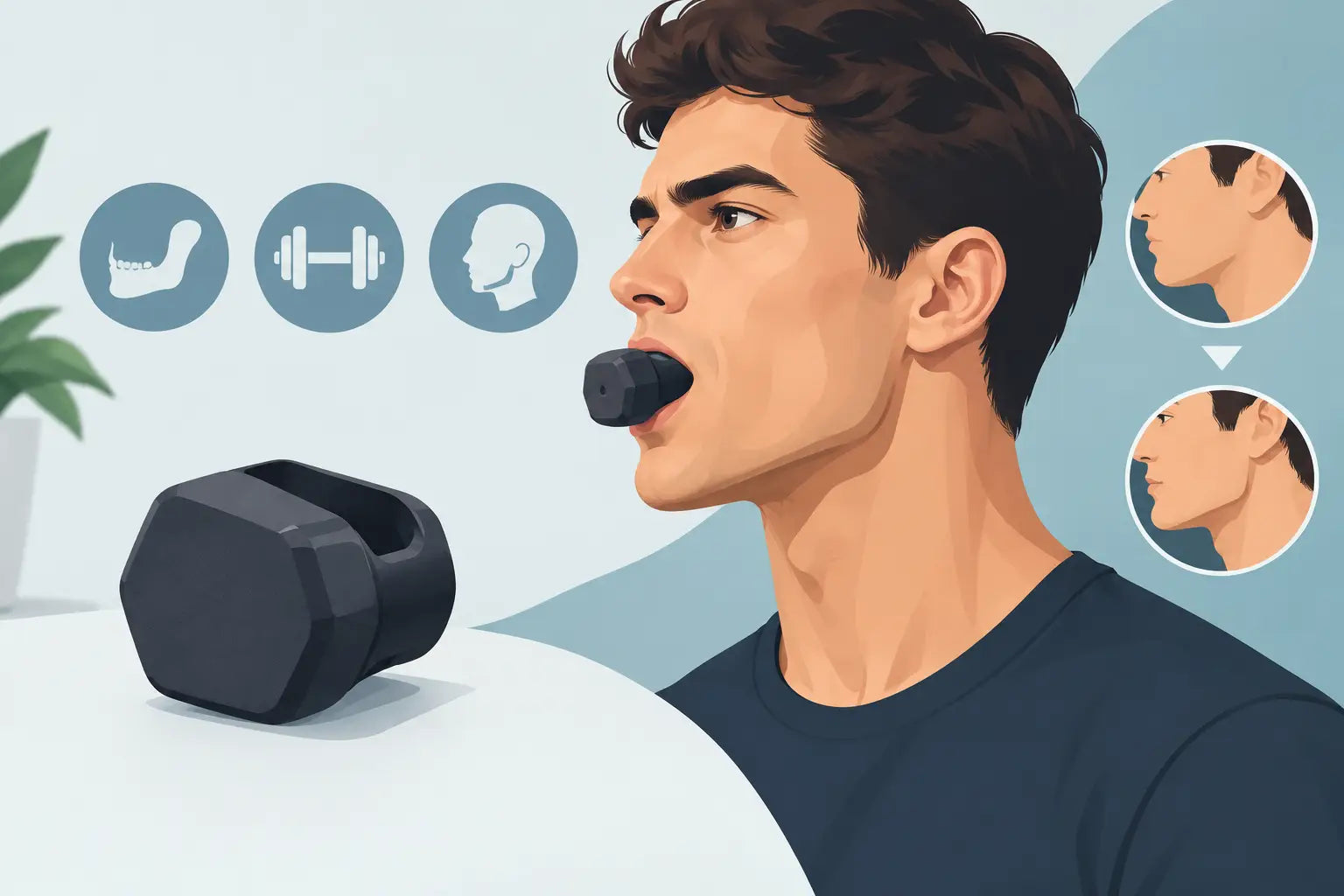
Purpose-built jaw exercisers are for more direct resistance training. Their shape gives you a consistent point of contact, and their resistance level makes your progression easier to organize. Instead of guessing whether a piece of gum is still firm enough, you can select a beginner, intermediate, or advanced level based on your experience.
This is the closest option to a traditional training tool. You have a repeatable movement, a defined resistance level, and a simple way to challenge yourself as your capacity improves. For people who like structure, that matters. A device can make a 10-minute session feel intentional rather than accidental.
The trade-off is that exercisers require more focus than gum. They are not made for all-day chewing. Use controlled reps, avoid rushing, and give your jaw time to adapt. If you notice pain, clicking, locking, headaches, or unusual discomfort, stop training and speak with a qualified healthcare professional before continuing.
Mewing Rings and posture-focused tools
Posture-focused tools serve a different role. Mewing Rings can help bring awareness to tongue placement and oral posture practice. They are not a replacement for chewing resistance, and they should not be judged by the same standard as gum or exercisers.
For someone building an appearance-focused routine, posture awareness can be a useful complement. Resistance work targets the muscles involved in chewing, while posture practice centers on how you carry your tongue and mouth at rest. They can belong in the same routine, but they solve different problems.
Choose the Right Tool for Your Starting Point
If you are a complete beginner, prioritize control over intensity. A beginner resistance gum or entry-level jaw exerciser is usually the smarter starting point because it lets you learn your tolerance without overwhelming your jaw. Keep sessions short. A consistent 10-minute routine is more valuable than an aggressive first week followed by a month off.
If you have already been chewing firmer gum regularly and your jaw feels comfortable with the workload, you may be ready for a more structured exerciser or stronger gum. This is where progression becomes useful. Increasing resistance gradually gives your masseters a new training stimulus while keeping the routine measurable.
Experienced users should still avoid treating high resistance like a badge of honor. Expert-level tools are for people who have built up to them. More resistance is only better when you can maintain controlled technique and recover comfortably. Your jawline routine should build confidence, not create constant soreness or strain.
JAWLINER organizes this progression in fitness terms: start where you are, build consistency, then move up when the current level no longer feels challenging. That approach makes product selection simple and keeps the focus on training rather than chasing extremes.
Gum vs. Exerciser: Which Delivers the Better Routine?
Neither option wins for everyone. Resistance gum is the better fit when convenience is your biggest obstacle. It is discreet, portable, and easy to work into a busy day. If the best program is the one you will actually follow, gum has a real advantage.
A jaw exerciser is better when you want a more deliberate session. It gives you clearer resistance, more repeatable positioning, and a stronger sense of progression. This makes it especially useful for people who already treat their appearance routine like training: schedule it, perform it with purpose, and track when it is time to level up.
Many people use both. Gum can support daily consistency, while an exerciser can anchor focused sessions. The key is not stacking excessive volume just because you own multiple tools. Your masseters need recovery just like the rest of your muscles.
How to Build a Smarter Jawline Training Routine
Start with one tool and one manageable routine. Aim for short, controlled sessions rather than random high-volume chewing. Keep your bite even from side to side, avoid clenching unnecessarily, and do not force your range of motion. Training should feel challenging in the muscles, not sharp or painful in the joints.
Give yourself time to assess recovery. Mild muscle fatigue can happen when you begin resistance work, especially if your jaw has never trained intentionally. Persistent discomfort is different. Reduce volume or resistance if your jaw feels overworked, and do not train through pain.
Your overall facial appearance also depends on factors no tool can replace, including body composition, genetics, sleep, grooming, hydration, and posture. A jaw trainer is not a shortcut around those variables. It is a focused addition for people who want to train the masseter muscles with the same discipline they bring to the gym.
The best choice is the tool that matches your current level, fits your schedule, and gives you a reason to show up tomorrow. Start controlled, stay consistent, and let progression earn its place in your routine.